
The Investor Is Already Using AI—Is Your Content Ready?
The investor is already in the room. The question is whether your content is ready for them.
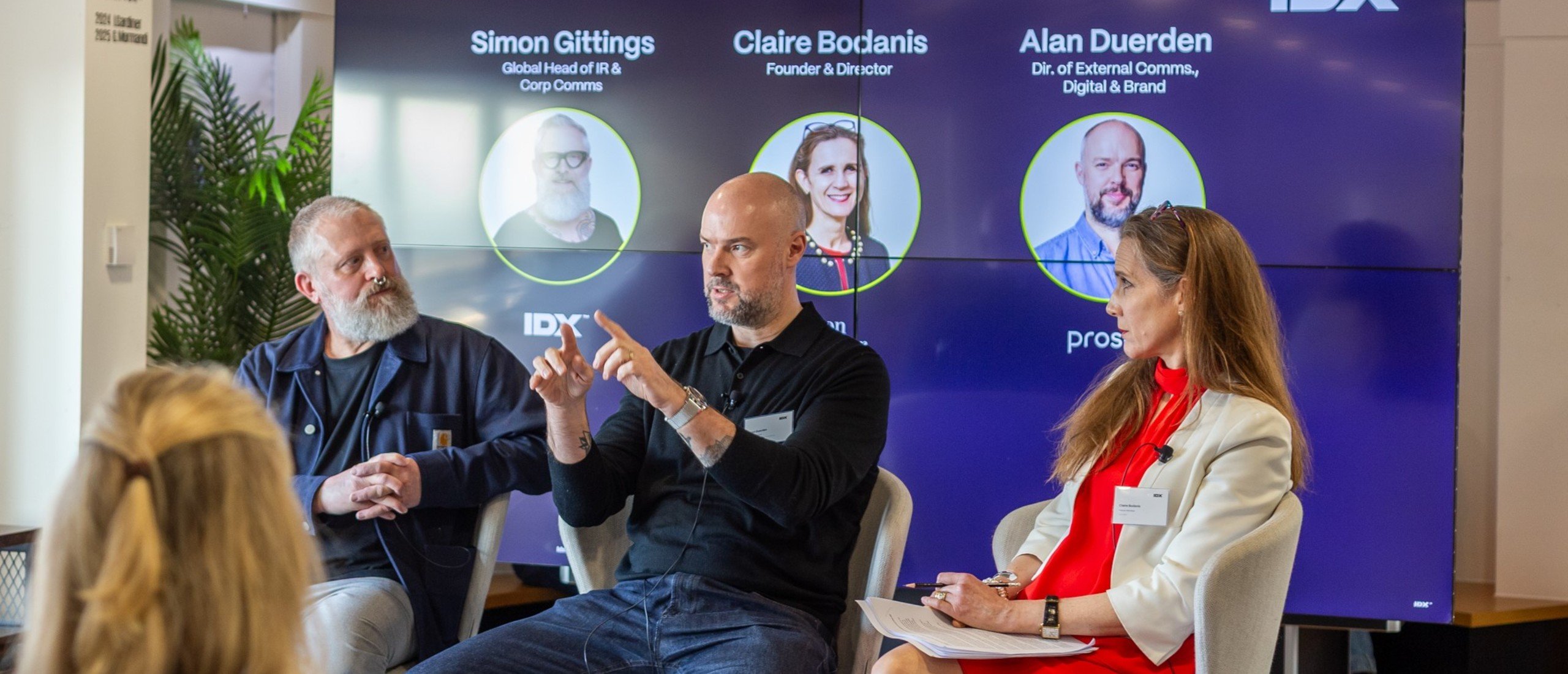
At IDX’s Agentic Workforce Breakfast Briefing on 19 March 2026, one point landed immediately. A senior portfolio manager at Allianz Global Investors now runs his entire research process on AI; sector analysis, company research, meeting preparation. By the time he meets management, the materials in front of him have been generated by machines, with only a thin layer of human framing. He is forming views on your business through systems your IR team has never briefed.
That shifts the centre of gravity.
Two positions, one outcome
We brought together two practitioners with deliberately different starting points. Alan Duerden, Director of External Communications and Brand at Prosus, has overseen the deployment of more than 40,000 AI agents across communications, legal, finance, ESG, and talent. Claire Bodanis, founder of Falcon Windsor and author of “Your Precocious Intern,” has built her perspective through work with FTSE companies and institutional investors on AI in corporate reporting.
Alan’s position was clear; agentic AI, when properly deployed, delivers operational value that prompt-based tools do not. Claire’s was equally clear; human authorship remains non-negotiable in regulated reporting.
On paper, those positions are opposed. In the room, they converged.
Start with workflow, not technology
Alan’s most practical point was also the most overlooked. Organisations start in the wrong place. They begin with the technology.
The right starting point is workflow. Map what your team actually does. Identify friction. Then build an agent around that specific problem.
At Prosus, adoption only accelerated when the AI team sat with non-technical functions and built systems around real working practices, rather than asking teams to adapt to a platform. It is a simple inversion, but it determines whether AI becomes embedded or ignored.
He drew a sharp distinction between prompt-based tools and agentic workflows. In his view, prompt-based AI remains an advanced chatbot. Operational value emerges when systems execute sequences of tasks autonomously, consistently, and at scale.
Where consensus emerged
The most telling moment came when Alan drew a line. He would not use AI for financial results communications, at least not in the near term.
Agentic workflows are already delivering value in thematic content and product communications. Regulated financial disclosure is different. The level of nuance, scrutiny, and internal alignment required keeps human judgement at the centre.
Claire, whose work argues strongly for human authorship in reporting, acknowledged the direction of travel. AI will be used. The question is whether it is used within clear guardrails and defined outcomes.
That is where both landed. Guardrails do not slow adoption; they enable it. The organisations making progress are not those moving fastest, but those creating the conditions for people to use AI well.
Experimentation first, coordination later
A consistent theme from Alan was the need to allow experimentation without over-coordination.
At Prosus, only a fraction of agents make it through. Most fail. That is expected. The value comes from discovering what works.
One communications example failed for a simple reason; a press clippings agent proved unreliable because it was searching for the letters "ft" rather than “Financial Times”, surfacing 300 irrelevant articles in a week. By contrast, an ESG-focused agent tracking gig economy developments in India delivered useful outputs.
The lesson is straightforward. You cannot design effective systems in the abstract. You have to test them in context. Restrict experimentation too early and you eliminate the learning that makes agentic AI valuable. Coordination belongs later, once there is something worth scaling.
What this means for IR and corporate communications
By 8:30 a.m., most of the room had already used AI in their work. A smaller group was experimenting with agents. This is the transition point; from individual use to organisational strategy.
The implication is not theoretical. If investors are already using AI to form views on your company before engaging with management, then the quality and structure of your content take on a different role.
AI answer engines are becoming the first point of contact with your narrative. Your corporate website is increasingly the verification layer, not the discovery layer.
That changes the standard. Content must be clear, consistent, and machine-readable. It must hold together when interpreted by systems you do not control.
A practical starting point
The takeaway we left the room with was deliberately simple.
Pick one workflow your team repeats every week. Map it honestly. Identify where human judgement is essential and where the work is simply moving information from one place to another.
That boundary is your opportunity. It is also where you start.
Let's chat
Whether you're looking for service, support or a future strategic partner - we're here to help.
LDN