
Digital Summit Tampa: AI Is Scaling Content; It’s Also Raising the Bar
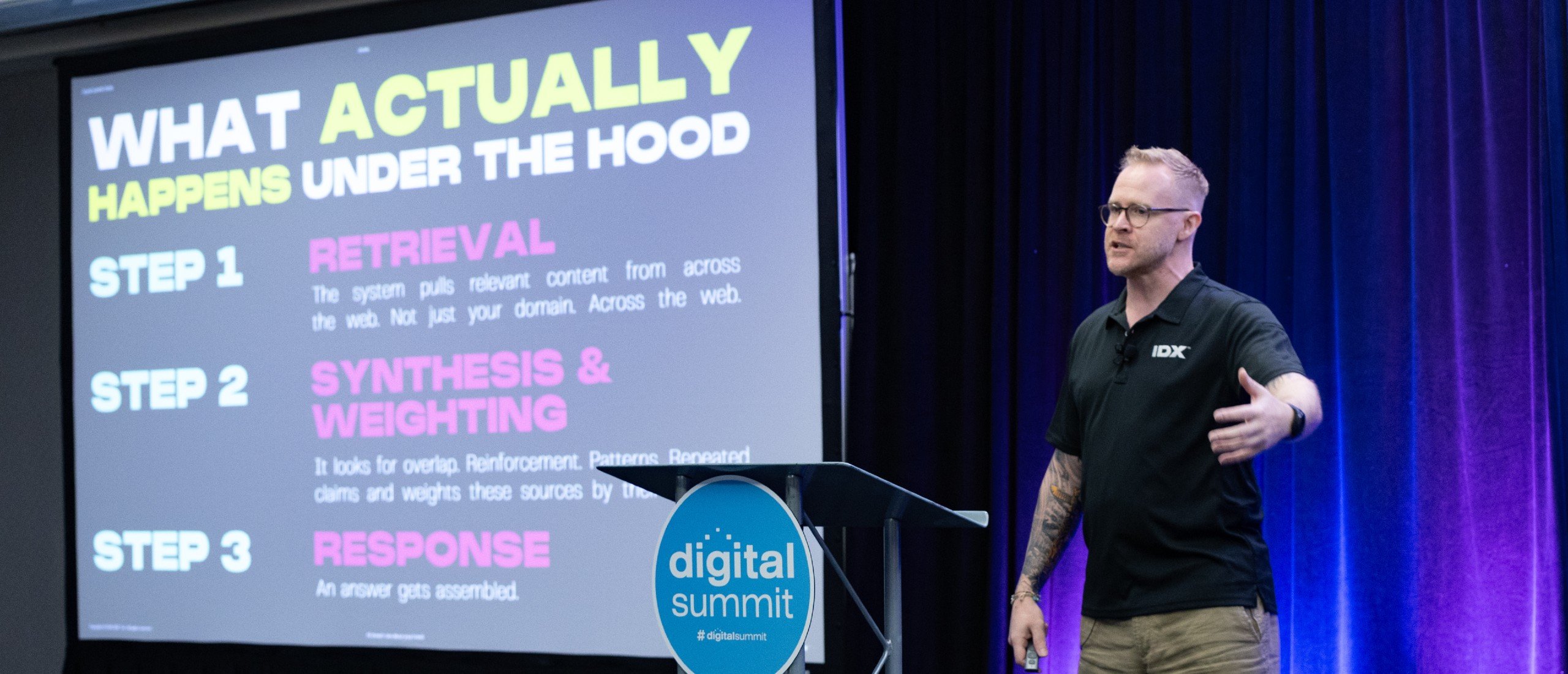
At Digital Summit Tampa, held March 17-18 2026, one theme dominated nearly every session, conversation, and corridor discussion: AI is no longer emerging. It’s embedded.
Across keynotes, panels, and side conversations, the focus wasn’t on whether to adopt AI; it was on what happens after you do.
And that’s where things got more interesting.
The Shift: From Production to Differentiation
AI has effectively solved for content production. The marginal cost of creating “something” is approaching zero.
What it hasn’t solved, and may actually be making harder, is differentiation.
Multiple sessions reinforced the same idea: surface-level content is being outpaced, not by better writing, but by better inputs. Original research, proprietary data, and full-funnel thinking are increasingly what separate signal from noise.
As one speaker put it, thought leadership is no longer a top-of-funnel exercise. It has to extend across the entire customer lifecycle, from initial discovery through post-sale engagement and into advocacy.
That’s a meaningful shift. It reframes content from a marketing output into a business asset.
Search Is Changing Faster Than Most Strategies
Another consistent theme: search behavior is evolving quickly under the influence of AI.
The takeaway isn’t just that AI search is growing. It’s that the nature of traffic is changing with it. Higher-intent queries, more specific comparisons, and increased reliance on aggregated answers are reshaping how users arrive and what they expect when they do.
Tactically, this is elevating certain content types:
-
Comparison pages
-
Structured FAQs
-
Research-backed assets
At the same time, third-party validation signals, such as reviews, authoritative mentions, and sources like Wikipedia, are playing a larger role in visibility and credibility.
One particularly notable (and debated) point: schema markup may have limited direct impact on AI-driven visibility. While still essential for traditional SEO, AI systems appear to prioritize language patterns and contextual authority over structured tagging alone.
Whether that holds long-term is an open question, but it reflects a broader trend: optimization is becoming less mechanical and more semantic.
The “Efficiency Illusion”
Perhaps the most grounded insight from the event: AI is not a shortcut to efficiency—at least not yet.
Despite widespread adoption, several sessions pointed to only marginal productivity gains. In some cases, AI is introducing new layers of complexity: more content to review, more outputs to validate, more systems to manage.
The result is what one presenter described as an “efficiency illusion.” Teams are moving faster, but not always further.
Without the right infrastructure, such as clear workflows, governance, and strategy, AI can amplify existing inefficiencies rather than eliminate them.
What We’re Seeing Beyond the Sessions
Outside the formal agenda, conversations with attendees revealed a parallel trend: many organizations are still dealing with foundational challenges.
Their concerns include site migrations, fragmented digital estates, and disconnected content systems. While these aren’t new problems, they’re becoming more urgent in an AI-driven environment. When content volume increases, fragmentation becomes more costly. When discovery shifts, inconsistency becomes more visible.
In that sense, AI isn’t just changing marketing. It’s exposing operational gaps that were easier to ignore before.
What This Means for Us (and Our Clients)
Coming out of Tampa, a few priorities are becoming clearer.
1. Double down on original insight
Commodity content will continue to lose ground. Investment in research, data, and perspective is no longer optional for brands that want to lead.
2. Design content for the full funnel
Thought leadership needs to connect pre-sale, conversion, and post-sale experiences. Isolated top-of-funnel assets won’t carry the same weight.
3. Re-evaluate search strategy through an AI lens
This means prioritizing intent-driven content, strengthening third-party validation, and adapting to how AI systems interpret relevance, not just how search engines index it.
4. Fix the foundation before scaling AI
Content operations, governance, and platform architecture matter more than tooling. Without them, AI introduces more friction than value.
5. Be selective about where AI adds value
Not every workflow benefits equally. The focus should be on high-leverage use cases, not blanket adoption.
Where This Is Heading
If there was a single throughline at Digital Summit Tampa, it’s this:
AI is compressing the gap between average and good. The gap between good and differentiated is getting wider.
Closing that second gap requires something AI can’t generate on its own: original thinking, structured execution, and a clear point of view.
That’s where the next phase of competition is already taking shape.
Let's chat
Whether you're looking for service, support or a future strategic partner - we're here to help.
LDN